
Selling your Colorado business can be a life-changing decision, but achieving top dollar requires careful strategy and preparation. Whether you’re ready to retire, pivot to a new venture, or simply capitalize on your hard work, understanding the nuances of the selling process is crucial. This ultimate guide dives deep into the essential steps to unlock your business’s full value, from enhancing its appeal to potential buyers to navigating the complex negotiations that follow. Discover insider tips on how to present your financials, market your business effectively, and position yourself for maximum profit. With the right approach, you can ensure that your exit from the business world is not just successful, but also rewarding. Join us as we explore proven techniques and expert advice, empowering you to sell your Colorado business with confidence and secure the financial future you deserve.
Understanding the Colorado Business Landscape
Selling a business in Colorado requires a comprehensive understanding of the local business environment. Colorado boasts a diverse and vibrant economy, with thriving industries such as technology, healthcare, agriculture, tourism, and energy. The state’s robust economic growth, coupled with its high quality of life, makes it an attractive location for both investors and entrepreneurs. Understanding the specific dynamics of your industry within Colorado is critical as it will influence how you position your business for sale and attract potential buyers.
Moreover, Colorado’s business climate is shaped by its regulatory framework, workforce availability, and market trends. The state’s business-friendly policies and incentives can be advantageous, but they also mean that buyers will be scrutinizing the local economic conditions closely. Familiarizing yourself with recent trends, such as population growth in key metropolitan areas like Denver and Boulder, can provide valuable insights into future market potential. These trends can be leveraged to highlight the growth opportunities your business offers to prospective buyers.
Networking within the Colorado business community is another essential aspect. Engaging with local chambers of commerce, industry associations, and business networks can provide you with useful information and contacts. These connections can help you identify potential buyers, stay informed about market conditions, and gain advice from peers who have successfully sold their businesses. Building a strong local presence and reputation can be a significant asset when it comes time to sell.
Is Selling Your Business Right For You?
- Is saving money on a broker’s commission important to me?
- Do you have the time to spend dealing with buyers and still run your business?
- Does your business earn enough profit to attract a buyer?
- Can your business operate by replacing you with the new owner after you provide some basic training during a transition period?
- Do you already have a good idea of who the likely buyer of your business will be?
- Will you be comfortable negotiating with a buyer?
- Will you be able to show the business to potential buyers and still maintain confidentiality?
- Will you seek professional help when a situation arises that you are uncomfortable with?
- Do you understand your business better than anyone else and have the ability to communicate the highlights to a potential buyer?
- Can you spend the time necessary to market the business?
- Are you willing to invest the time that it takes to determine the correct market value of the business?
- Are you willing to spend your own time preparing the materials necessary to present the business to buyers?
- Are you willing to take a hard look at your business and consider ways to make it more appealing to buyers?
- Will you be comfortable dealing with attorneys, accountants and bankers?
- Are you ready to sell your business if the right deal comes along?
Preparing Your Business for Sale
Preparation is key to ensuring your business is attractive to potential buyers and commands a high selling price. The first step in preparing your business for sale is to get your financial house in order. This means having clear, accurate, and up-to-date financial statements, including profit and loss statements, balance sheets, and cash flow statements. Buyers will want to see a detailed financial picture to assess the viability and profitability of your business. Consider hiring a professional accountant to audit your financials and ensure everything is in top shape.
In addition to financial preparation, operational aspects of your business should be optimized. This includes streamlining processes, documenting standard operating procedures, and ensuring that all business operations run smoothly without your direct involvement. A business that can demonstrate operational efficiency and independence from the owner is more appealing to buyers, as it suggests a seamless transition of ownership.
Enhancing the physical and digital presence of your business can also make a significant difference. This could involve updating your premises, refreshing your brand, and optimizing your online presence. A business that is well-presented and maintains a strong brand identity can attract more interest and justify a higher asking price. Additionally, addressing any outstanding legal or regulatory issues before putting your business on the market is crucial, as unresolved issues can deter buyers and complicate the sale process.
Valuation: How to Determine Your Business Worth
Determining the accurate value of your business is one of the most critical steps in the selling process. A proper valuation ensures that you receive a fair price and provides a benchmark for negotiations. There are several methods to value a business, including the income approach, the market approach, and the asset-based approach. Each method has its own set of considerations and may be more suitable depending on the nature of your business.
The income approach focuses on the future earning potential of the business. This involves projecting future revenues and profits and discounting them back to their present value. The discount rate reflects the risk and time value of money. This method is particularly useful for businesses with stable cash flows and predictable earnings. However, it requires accurate financial projections and a thorough understanding of market risks.
The market approach compares your business to similar businesses that have been sold recently. This method relies on market data and multiples, such as price-to-earnings ratios, to estimate the value. It can be an effective approach if there is sufficient market data available for comparable businesses. Finally, the asset-based approach values the business based on its net asset value, which is the difference between total assets and liabilities. This approach is often used for businesses with significant tangible assets, such as real estate or machinery.
Legal Considerations When Selling a Business in Colorado
Navigating the legal aspects of selling a business in Colorado requires careful attention to detail and compliance with state and federal regulations. One of the first legal steps is to draft a comprehensive sale agreement that outlines the terms and conditions of the sale. This document should cover the purchase price, payment terms, liabilities, warranties, and any contingencies. Engaging a business attorney with experience in Colorado business sales is highly recommended to ensure that the agreement is legally sound and protects your interests.
Another important legal consideration is addressing any existing contracts and obligations. This includes leases, supplier agreements, employment contracts, and customer contracts. You will need to review these documents to determine if they are transferable to the new owner or if any amendments are required. Additionally, it is important to comply with Colorado’s bulk sales laws, which are designed to protect creditors by ensuring they are notified of the sale and have an opportunity to claim any outstanding debts.
Tax implications are also a critical aspect of the legal process. Selling a business can have significant tax consequences, and it is important to understand how the sale will impact your tax liability. This includes federal, state, and local taxes, as well as any potential capital gains taxes. Consulting with a tax advisor who understands the complexities of business sales can help you plan for these tax implications and explore strategies to minimize your tax burden.

Marketing Your Business to Potential Buyers
Effective marketing is essential to attract potential buyers and create competition, which can drive up the selling price. The first step in marketing your business is to create a compelling business profile that highlights its strengths, growth potential, and unique selling points. This profile should include detailed information about your business’s operations, financial performance, market position, and any competitive advantages. High-quality visuals, such as professional photographs and videos, can also enhance the appeal.
Once you have a strong business profile, you can start targeting potential buyers. There are several channels to consider, including online business marketplaces, industry-specific platforms, and local business networks. Listing your business on reputable websites that specialize in business sales can expose it to a wide audience of potential buyers. Additionally, leveraging your network and engaging with business brokers can help you reach serious and qualified buyers who may not be actively searching online.
Confidentiality is a crucial aspect of marketing your business. You want to generate interest without alerting competitors, employees, or customers prematurely. Implementing non-disclosure agreements (NDAs) and carefully vetting potential buyers can help protect sensitive information. Providing detailed information only to qualified and serious buyers ensures that the sale process remains discreet and does not disrupt your business operations.
The sales process involves several key steps, each of which requires careful planning and execution. The first step is to conduct a thorough due diligence process. This involves gathering and organizing all necessary documentation, including financial statements, tax returns, legal documents, and operational records. Potential buyers will conduct their own due diligence, and having all the necessary information readily available can streamline the process and build trust.
Once due diligence is complete, you can move on to negotiating the terms of the sale. This includes discussing the purchase price, payment terms, and any contingencies. Effective negotiation skills are essential to achieve a favorable outcome. It is important to be prepared, understand the buyer’s perspective, and be willing to compromise on certain terms while holding firm on others. Engaging a professional negotiator or business broker can provide valuable support during this phase.
After reaching an agreement, the next step is to finalize the sale. This involves drafting and signing the sale agreement, transferring ownership, and addressing any remaining legal or financial obligations. Ensuring a smooth transition is critical to maintaining business continuity and preserving relationships with employees, customers, and suppliers. Providing support and training to the new owner during the transition period can help ensure a successful handover and protect the legacy of your business.
Common Mistakes to Avoid When Selling Your Business
Selling a business is a complex process, and there are several common mistakes that can hinder your chances of achieving a successful sale. One of the most common mistakes is failing to prepare adequately. This includes not having up-to-date financial records, not addressing legal or operational issues, and not having a clear plan for the sale. Proper preparation is essential to present your business in the best possible light and attract serious buyers.
Another mistake is overvaluing or undervaluing your business. Setting an unrealistic asking price can deter potential buyers, while undervaluing your business can result in leaving money on the table. Conducting a thorough and accurate valuation, considering market conditions and comparable sales, can help you set a realistic and competitive asking price. Engaging a professional appraiser or business broker can provide valuable insights and ensure your business is priced correctly.
Lack of confidentiality is another common pitfall. Disclosing the sale prematurely can create uncertainty among employees, customers, and suppliers, potentially disrupting business operations. Implementing confidentiality agreements and carefully managing the flow of information can help protect your business and maintain stability during the sale process. Additionally, it is important to be patient and not rush the sale. Taking the time to find the right buyer and negotiate favorable terms can significantly impact the outcome.
Working with Business Brokers: Is it Worth it?
Engaging a business broker can provide valuable support and expertise throughout the sale process, but it is important to weigh the pros and cons before making a decision. One of the main advantages of working with a business broker is their experience and knowledge of the market. Brokers have access to a network of potential buyers, understand current market trends, and can provide guidance on pricing and negotiation strategies.
However, there are also potential drawbacks to consider. Business brokers typically charge a commission, which is a percentage of the sale price. This can be a significant cost, especially for smaller businesses. It is important to carefully review the terms of the broker’s agreement and understand the fee structure. Additionally, not all brokers have the same level of expertise or experience, so it is important to conduct thorough research and choose a reputable broker with a proven track record.
Business brokers can also save you time and effort by handling many of the tasks involved in the sale process. This includes marketing your business, vetting potential buyers, managing due diligence, and facilitating negotiations. By delegating these responsibilities to a professional, you can focus on running your business and maintaining its value during the sale process. Additionally, brokers can provide an objective perspective and help you make informed decisions. Let’s look at the benefits of working with a business broker in more detail.
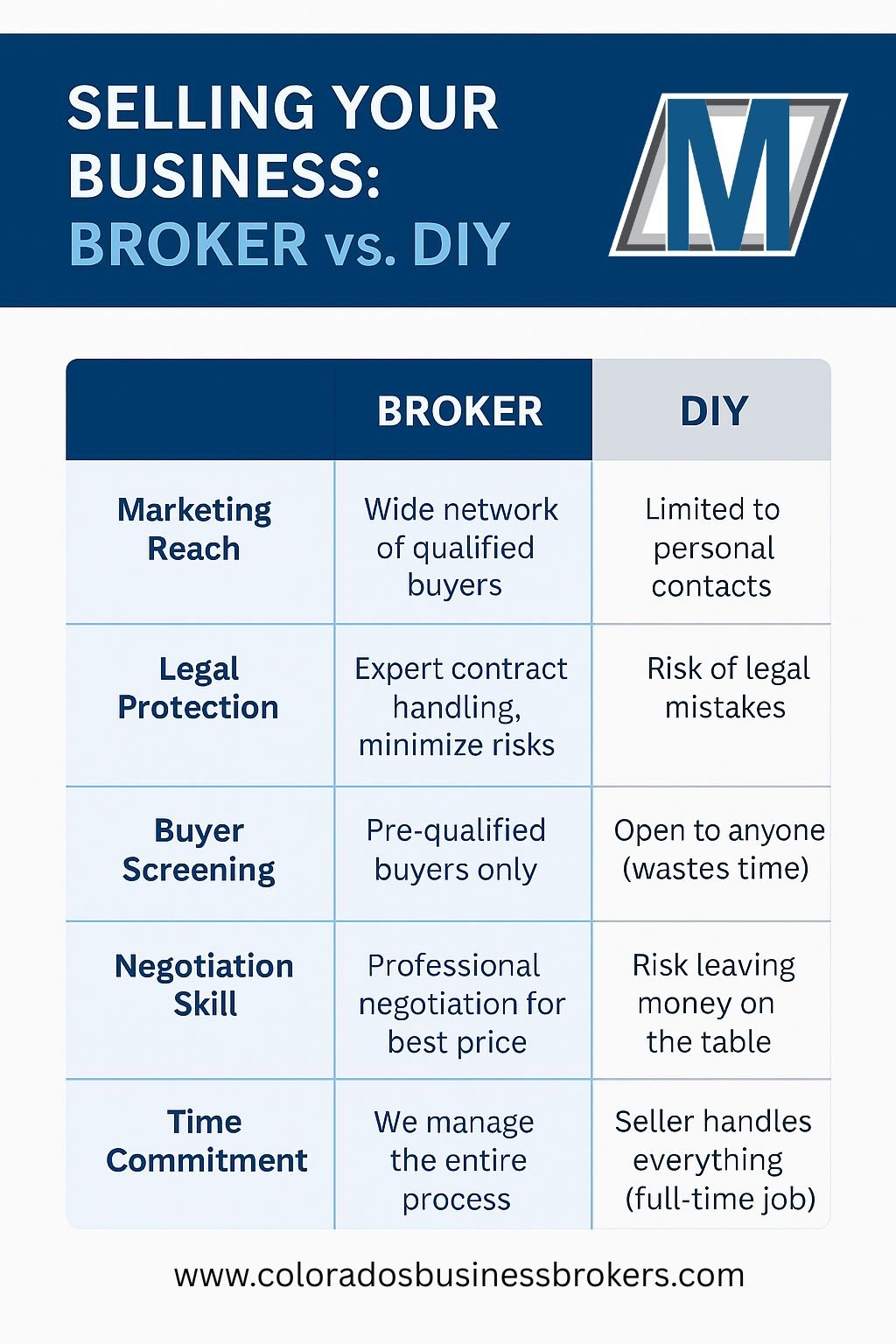
10 Benefits of Working with a Business Broker
1. Accurate Business Valuation
One of the biggest mistakes business owners make when selling is mispricing their business. Price it too high, and you scare away buyers. Price it too low, and you leave money on the table.
Murphy Business Brokers uses industry-leading valuation tools, market data, and financial analysis to determine the true market value of your business. We consider everything from cash flow and assets to industry trends and comparable sales in Colorado and beyond. With a broker, you get a professional, unbiased valuation that sets you up for a successful sale.
2. Confidentiality Protection
Maintaining confidentiality is critical during the sale of a business. If employees, customers, or competitors learn your business is for sale, it can lead to uncertainty, loss of clients, or operational disruption.
At Murphy Business Brokers, we implement strict confidentiality protocols. We market your business without revealing its identity and screen all buyers through confidentiality agreements before disclosing sensitive information. This keeps your business running smoothly while we work behind the scenes to secure the right buyer.
3. Access to a Larger Pool of Buyers
One of the biggest advantages of working with a business broker is access to a wide network of qualified buyers. Murphy Business Brokers has an extensive database of pre-screened individuals, investors, and companies actively looking to acquire businesses in Colorado.
We also leverage national and global listing platforms to give your business maximum exposure, while still keeping its identity confidential. This targeted marketing ensures your business is seen by serious buyers—those who are financially capable and genuinely interested.
4. Expert Marketing and Presentation
A business broker knows how to market your business effectively. At Murphy Business Brokers, we prepare professional marketing packages that highlight your business’s strengths, financial performance, and growth potential. These documents are designed to attract interest and give buyers the information they need to move forward.
We also use strategic advertising, online listings, and networking to promote your business to the right audience, all while maintaining a professional and appealing image of your company.
5. Negotiation Expertise
Selling a business involves complex negotiations, from price and terms to financing and transition agreements. As your broker, we act as a buffer between you and the buyer, handling these negotiations to keep emotions in check and protect your best interests.
Our brokers have years of experience negotiating deals and overcoming obstacles that can derail a sale. We work hard to achieve the best possible outcome for you—often securing higher prices or better terms than you could on your own.
6. Transaction Management and Due Diligence Support
Once you’ve found a buyer, the real work begins. A business sale involves legal documents, financial disclosures, inspections, and sometimes third-party financing. Keeping everything organized and on schedule is essential to closing the deal.
Murphy Business Brokers manages the entire transaction process from start to finish. We coordinate with attorneys, accountants, lenders, and other professionals to make sure everything proceeds smoothly. We also help facilitate the due diligence process, ensuring that buyers get the information they need without overwhelming you or disrupting operations.
7. Higher Sale Price
Time and again, research shows that businesses sold through a broker sell for more money than those sold privately. That’s because brokers bring professional valuation, negotiation skills, and access to more buyers—leading to a more competitive process and stronger offers.
At Murphy Business Brokers, our goal is to help you walk away with maximum value. We know how to position your business for success and create a sense of urgency among qualified buyers.
8. Time Savings for the Owner
Selling a business is time-consuming, and if you try to do it yourself, it can quickly become a full-time job—on top of running your business.
By hiring Murphy Business Brokers, you free up your time to focus on what matters most: continuing to operate your business profitably until the sale is complete. We handle all the legwork, from buyer screening to documentation, so you don’t have to.
9. Local Knowledge with National Reach
As a Colorado-based business broker, Murphy Business Brokers brings deep local knowledge of the state’s business environment, industries, and buyer trends. Whether your business is in Denver, Colorado Springs, Boulder, or a rural mountain town, we understand what makes it valuable in the local market.
At the same time, we’re part of a national network of Murphy Business & Financial Corporation offices, giving us connections across the U.S. This combination of local expertise and national reach sets us apart from other brokers.
10. Peace of Mind
Perhaps the biggest reason to work with a business broker is peace of mind. Selling your business is a life-changing event—there’s too much at stake to go it alone.
With Murphy Business Brokers, you have a trusted advisor by your side, guiding you through every decision with honesty, professionalism, and proven experience. We handle the details so you can focus on your future, confident that your business is in good hands.
Download your Free Guide on Preparing your Business to Sell.

Closing the Deal: Final Steps to a Successful Sale
Closing the deal is the culmination of the sale process and requires careful attention to detail to ensure a smooth transition. The first step in closing the deal is to finalize the sale agreement. This document should clearly outline all the terms and conditions of the sale, including the purchase price, payment terms, and any contingencies. It is important to review the agreement thoroughly and seek legal advice to ensure that your interests are protected.
Once the sale agreement is signed, the next step is to transfer ownership. This involves transferring assets, updating legal and financial records, and notifying relevant parties, such as customers, suppliers, and employees. Ensuring a seamless transfer of ownership is critical to maintaining business continuity and preserving relationships. Providing support and training to the new owner during the transition period can help ensure a successful handover.
Finally, it is important to address any remaining legal and financial obligations. This includes settling any outstanding debts, paying taxes, and fulfilling any contractual obligations. Closing the deal also involves receiving the final payment and ensuring that all financial transactions are completed. By taking the time to carefully manage these final steps, you can ensure a smooth and successful sale and set the stage for your next venture or retirement.
Post-Sale Considerations and Next Steps
Once the sale is complete, there are several important post-sale considerations and next steps to address. One of the first steps is to manage the tax implications of the sale. This includes reporting the sale to the IRS, paying any capital gains taxes, and addressing any state or local tax obligations. Consulting with a tax advisor can help you navigate the complexities of tax reporting and ensure compliance with all regulations.
Another important consideration is managing the proceeds from the sale. This includes developing a financial plan for how to invest or use the funds. Whether you plan to retire, start a new business, or invest in other opportunities, having a clear plan can help you achieve your financial goals. Working with a financial advisor can provide valuable guidance and help you make informed decisions about managing your wealth.
Finally, it is important to take the time to reflect on your achievements and plan for the future. Selling a business is a significant milestone, and it is important to acknowledge your hard work and success. Whether you choose to take a well-deserved break, pursue new ventures, or engage in philanthropy, having a clear vision for the future can help you transition smoothly and embrace new opportunities. By carefully considering your post-sale options and planning for the future, you can ensure that your exit from the business world is both successful and rewarding.
Ready to Sell Your Business in Colorado?
If you’re considering selling your business, don’t take chances. Contact Murphy Business Brokers of Colorado today for a confidential consultation. We’ll help you understand what your business is worth, how to prepare it for sale, and what to expect from the process. With the right guidance and support, you can make a profitable, smooth exit—and take the next step toward your future.
Let’s make your business sale a success.